Hertfordshire CRIME & PUNISHMENT WITH EIGHTY-FIVE EXECUTIONS BETWEEN 1731-1903
Executions had taken place at Gallows Tumps, in Hereford, and at St. Olave’s Street, Hereford, and from August 1796, at Hereford County Gaol, executions had taken place upon the flat roof of the entrance to the gaol.
Some doubt exists as to the precise number of criminals buried within the precincts of the prison as the relatives had the option of claiming the bodies, except in cases of murder, when they were invariably handed over for dissection.
During the War of the Roses (English Civil War) 1455-1487, fought between the House of Lancaster (Red Rose) and the House of York (White Rose) Sir Owen Tudor born c. 1400, at Anglesey in Wales, founder of the Tudor dynasty, and Great grandfather of Henry VIII. Owen a Lancastrian was after the defeat at the Battle of Mortimer’s Cross, at Kingsland in Herefordshire, on the 2nd of February 1461, beheaded. He was buried at Greyfriars Church, in Hereford.
John Kemble, born circa 1599 at St. Weonards in Herefordshire, was an English Catholic priest. The Crown sentenced him to be hanged, drawn, and quartered for his preaching. Kemble was executed on the 22nd of August 1679, at Widemarsh Common in Hereford. Notably, he was permitted to die before the customary procedure of drawing and quartering was carried out.
Before the transportation Act of 1717/18 (The Piracy Act 1717) most criminals were either whipped, branded, or sentenced to death. Long terms of imprisonment were virtually unheard-of.
From May 1718, up to the start of the War of Independence in April 1775, an estimated 50,000, British criminals were transported, who on arrival were sold into slavery.
Between 1775-1787, convicts sentenced to transportation remained in over-crowned gaols, until the introduction of Prison Hulks (Derelict decommissioned warships) moored mainly in the River Thames, and offshore waters like Plymouth and Bristol. The convicts were sent to hard labour during the day and lived in barbarous, disease-ridden and deadly conditions on the Prison Hulks.
During this time some convicts were transported to Africa. On the 13th of May 1787, the first Fleet set sail from Portsmouth, arriving at Sydney Cove, New South Wales, Australia, in January 1788.
THE 1730'S
1732
At the March Assizes 1731/32, two men were condemned to death: J. Jones for stealing several sums of money from his master; Robert Weaver for the robbery and barbarous murder of Thomas Matthews a bailiff, to Mr. Monington, in the parish of Webley. Jones was later reprieved. Two persons were burnt in the hand and eight were ordered to be whipped.
- Robert Weaver was executed on the 27th of March 1731/32, he was afterwards hanged in chains on White Hill.
After a few days his body was stolen off the gibbet. Weaver’s accomplice a man named William Sayfell, who confessed the fact, was admitted in evidence against Weaver.
Weaver when brought to the Bar, was very stubborn and obstinate, he refused to plead to his indictment, whereupon the Judge ordered his thumbs to be twisted with a whipcord, which he endured till they were cut to the bone, his trial was deferred on account of the absence of two witnesses. On being tried two days later it was fully proved that he fired the pistol with which Mr. Matthews was shot dead. He was thereupon found guilty and sentenced to be hanged in chains near the place where he committed the said robbery and murder. While under sentence of death he had signed a written confession of his guilt.
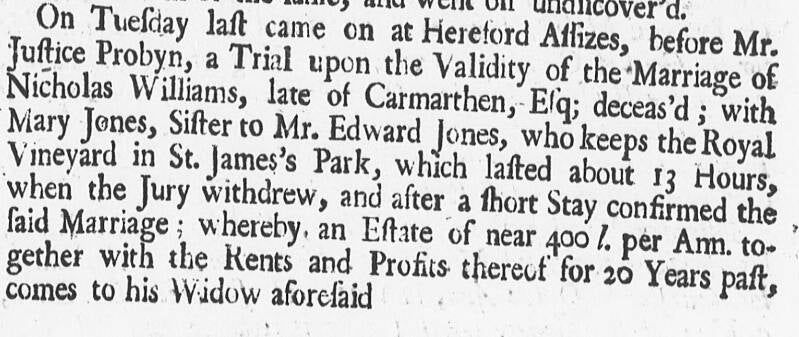
The Derby Mercury Thursday 24th August 1732.
1733
March 1733: Richard Winsmere for horse stealing; Thomas Raper for house breaking; William Wilson and William Robinson were convicted of forgery, all four were capitally convicted and left for execution. The last two men were reprieved and ordered to be transported for fourteen years.
Thomas Winter for stealing goods from a dwelling house was sentenced to seven years transportation.
Three other men were tried William Green, Thomas Jenkins with house breaking, and Walter Preece for horse stealing, the outcome of all three men is unknown.
Richard Winsmere or Wilsmere for Horse stealing and Thomas Raper for a burglary, were executed by hanging on Saturday the 24 March 1733.

The Gloucester Journal Tuesday 13th March 1732-33

The Gloucester Journal 27 March 1732/33
1. Richard Winsmore was born to honest yet mean parents; he believed his troubles began with his father's death and his mother's excessive indulgence, which allowed him to waste the small amount his father had managed to save.
He acknowledged that the principal cause was owning to the depravity of his will; in readily complying with the evil instructions he had received from the bad company he fell into.
He had also confessed that he was guilty of the crime he was to suffer for, and heartily begged pardon of God not only for that, but all other whether known or concealed. That he desired his Countrymen not to entertain an ill opinion of those whom he had wrongfully accused of being in a confederacy with him; and concluded with recommending his wife and children to the care and providence of the almighty.
2. Thomas Raper upon his own confession had said, that he was about 27 years old, that he had courted a young woman who gave birth to his child, and having so much respect for her they lived together for a considerable time as man and wife.
But the woman had set her affections upon another man, so Thomas walked away from the relationship and took to the road, upon his travel’s he had the misfortune to buy a horse from a man for 35s., who as they were riding together, informed him that he had stolen the said horse and five more beside, and returned him half his money.
There had parted company and on arriving at Gloucester, where he was arrested, committed to the County Gaol for horse stealing. While in gaol he met with Charles Winter, who persuaded him to break out of gaol with him.
After three days on the run without food, they come upon a house of Mr. Noble, in Herefordshire. Winter said that he had formerly lived there and knowing the ways of the house would go and fetch some food and drink. He brought some bread and cheese and cider, and other articles that were unknown to him. Thomas had told Winter not to meddle with anything else apart from the food and drink.
After the said robbery, the two men were pursued and taken, Winter being killed in resisting the persons who had followed them.
Summer Assizes which ended on the 17th of July 1733: John Williams for stealing out of the Mill house, of Richard Munn several garments belonging to his (Richard Mann’s) servants, was capitally convicted and received sentence of death.
John Ralph, John Saife and John Hallings all three were ordered to be transported for seven years.
Mary and Catherine Thomas were burnt in the hand. And one man was ordered to be whipped.
On Thursday the 15th of October 1733, six prisoners sentenced to transportation, were removed from Hereford gaol, under a strong guard to Bristol, to be shipped off to His Majesty’s Plantations in America.
Right: The Gloucester Journal Tuesday 7th August 1733
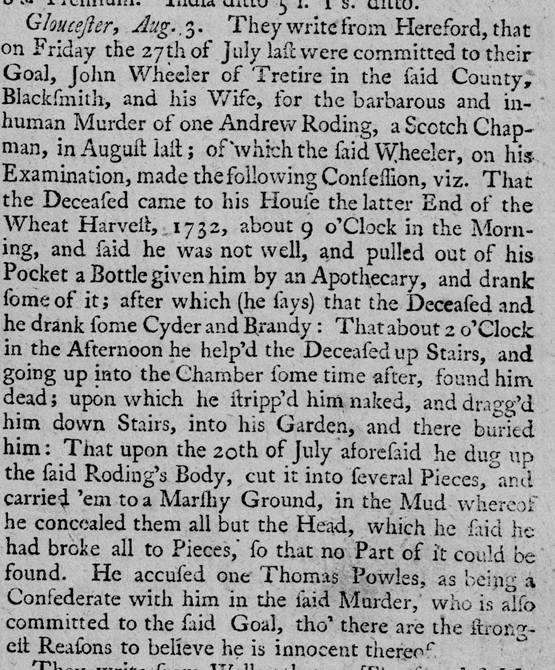
1734
At the March Assizes, John Wheeler was condemned for the barbarous murder of Mr. Andrew Rudi or Roding a Scotchman. Wheeler’s wife, and Thomas Powles were acquitted of the said murder.
Edward Parlour was condemned for the murder of Richard West.
Mary Taylor was ordered for transportation, and Thomas Williams was burnt in the hand.
3. John Wheeler executed on Saturday the 6th of April 1734 and afterwards hanged in chains near the place where the murder was committed, at Ross, in Herefordshire.
Wheeler a blacksmith had in October 1733, tried to commit suicide by cutting his throat while in his cell at Hereford gaol. His behaviour to the last was obstinate and wicked. He confessed that he was concerned in the murder of his first wife and that he strangled his own child, which he said had smiled at him while he was dying.
4. Edward Parlour for the murder of Richard West, executed in April 1734, he behaved quite contrary to Wheeler, showing great signs of sorrow and repentance.
1736
At the August Assizes, John Taylor was condemned for horse stealing but afterwards reprieved and left for transportation; William Jones for stealing was ordered to be transported for seven years; John and Elizabeth Palmer, Francis Baylis and Benjamin Bach were ordered to be whipped for stealing wheat.
1737
Two men were condemned to death at the March Assizes, William Sutor with uxoricide and John Griffiths for a burglary. Griffiths was later reprieved and transported.
5. William Sutor executed on Saturday the 2nd of April 1737, for uxoricide (the murder of one’s wife.) Sutor had confessed to the fact that he killed his wife Catherine, but said he did not do it deliberately, being provoked thereto in his passion, he acknowledged himself to be a very heinous sinner and deserving in death. He forgave everybody and prayed to God to forgive him, and to all outward appearance was very penitent. He was so illiterate before his condemnation that he could not say the Lord’s-prayer.
Thomas Hughes was sentence to death for horse stealing, at the Summer Assizes in August, but afterwards reprieved.
John Done and Robert Matthews were ordered for transportation. Four over convicts were ordered to be whipped.
Walter Evans was fined three marks and a year’s imprisonment, for an assault with intent to ravish one Joan Grub a woman near 60-year of age.
1738
At the Lent Assizes held in March fourteen persons were tried. Four were condemned to death, eight were sentence to transportation and two were ordered to be whipped. Two were afterwards reprieved. William Summers and John Tippin were executed on Saturday the 25th of March 1738:
6. William Summers for house breaking.
7. John Tippin for house breaking. They behaved in a very penitent manner but made no confession. At the tree the hangman was intoxicated and believing there were three persons ordered for execution, he tried to put one of the ropes about the parson’s neck as he stood in the cart and with much difficulty, he was prevented by the gaoler from doing so.
At the summer assizes in August, two individuals were sentenced to death: Joseph Babington for horse theft and Thomas Reece for the theft of a gold ring and other items. It remains unclear whether Joseph Babington and Thomas Reece received reprieves or were executed.
THE 1740'S
1740
At the March Assizes in 1740 Richard Price and Joseph Hawkins were capitally convicted and received sentenced of death for house breaking, on consideration of their youth the Judge reprieved them.
Four prisoners were transported, and one ordered to be whipped.
In July 1740, John Morgan was sentenced to death for being at large; however, it is unclear whether his sentence was commuted or carried out.
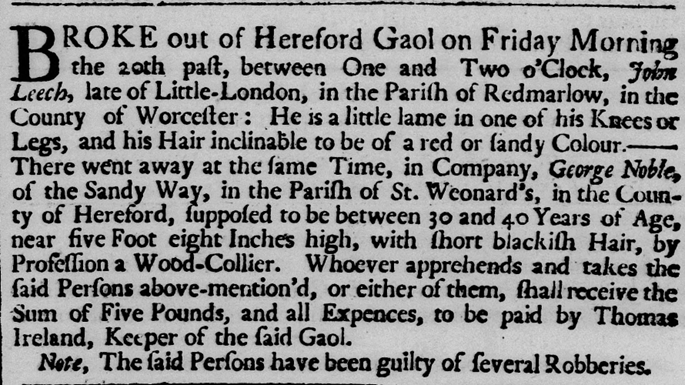
The Gloucester Journal 1st July 1740.
1741
John Summers was condemned to death in March, outcome unknown, it’s believed he had been transported along with four others who were also condemned to death.
Four men were capitally convicted and condemned to death, at the assizes in July: John Williams for horse stealing; Anthony Matthews for house breaking; James Collins and John Mason for sheep stealing.
Collins and Mason being were reprieved. The outcome for Williams and Matthews remains unknown.
1742
In January 1742, James Collins and Robert Jacob the elder, escaped from the County Gaol at Hereford. Collins who was condemned for sheep stealing in July 1741, was 5 foot 6 inches, well-built with long straight black hair, he lived within a mile of Bromyard.
Jacob was about 5 foot 10 inches tall, and well-set, full face with a fresh complexion, and an old light-brown wig, by trade a butcher, he lived at Cricklade in the County of Wiltshire, he was committed to Hereford Gaol for stealing two fat cows from Mr. Edward Read of Little Brunsdon.
When they made their escape, they were double-ironed, wearing only breeches, shirts and stockings. Thomas Ireland, Keeper of the Gaol, offered five guineas per man as a reward.
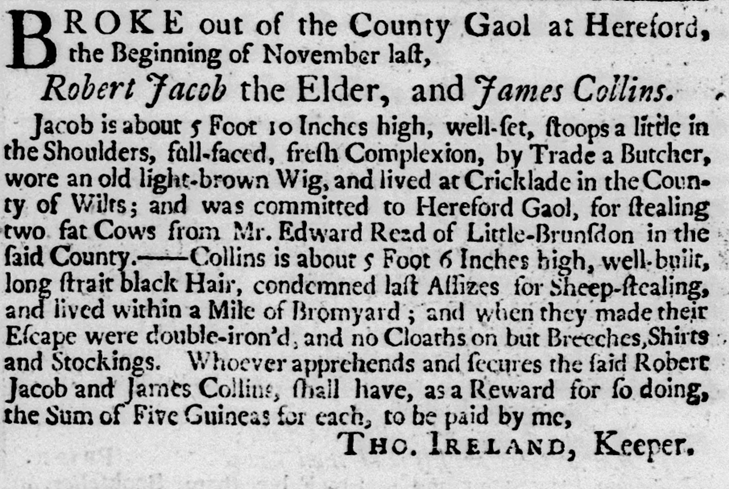
The Gloucester Journal Tuesday 26th January 1741/2
At the March Assizes: John Stevens was capitally convicted and received sentence of death, for sheep stealing. Outcome unknown.
1743
Thomas Perry was condemned at the March Assizes, for being at large, maybe the same man as Thomas Reece who was condemned and later reprieved in August 1738, for stealing a gold ring.
Three prisoners were condemned to death in August, and afterwards reprieved. Thomas Davies for horse stealing; Thomas Pendro for sheep stealing; and Edward White or Whitefoot.
Thomas Davies and Edward White were reprieved and ordered to be transported for 14 years.
Outcome of Thomas Pendro unknown.
1744
At the March Assizes, William Jones was burnt in the hand for stealing pigs. Elizabeth Manning was ordered to be whipped.
Thomas Newton was capitally convicted at the summer assizes in July and received sentence of death for uxoricide. Newton was a no good, wife beating “son of a bitch.” He had within a few years three wives, and was violent, cruel and barbarous to each of them. Newton lived in the parish of Bodenham. His third wife Joan was found dead in the River Lugg, her skull was fractured, her arm was broken and she had several marks of violence around her body.
There are no available records regarding his execution or any possible reprieve; thus, the outcome remains uncertain.
1746
Mary Bullock was capitally convicted at the March assizes, for stealing a horse, another two unnamed persons were also condemned, all three were reprieved.
Three prisoners were condemned to death, at the summer assizes in August but were all reprieved, George Rainforth for burglary, William Floyd and Thomas Pantall for sheep stealing.
1748
On the 15th of March, the assizes ended, when two persons received sentence of death, Anthony Baynham for sheep stealing and John Aspey for stealing a cow, both were afterwards reprieved.
1749
Four persons were capitally convicted and received sentence of death, at the March Assizes: William Hooper and Thomas Gilbert for sheep stealing. John Morris for horse stealing and Mary Monk for setting fire to the house of James Gittus in the Parish of Stanford Bishop.
Afterwards, Morris was left for execution, Hopper and Gilbert were reprieved. But the outcome of Mary Monk is completely unknown.
8. John Morris was executed in March/April 1749, for horse stealing.
THE 1750'S
1751
Seven persons were condemned to death at the March Assizes: James Moore alias Morse, for robbing on the highway, was left for execution and hanged the following month.
Anne Havard for house breaking, was left for execution, the outcome for Anne, is unknown.
William Edwards and John Davis for horse stealing; James Lewis for sheep stealing; James Watkins for stealing goods to the value of 40s., out of a dwelling house; and Jane Jones for picking pockets were all afterwards reprieved.
Daniel Hill for uttering counterfeit money, was burnt in the hand. Four prisoners were ordered to be transported and one to be whipped.
9. James Morse alias Moore was executed in April 1751, for highway robbery.
1752
William Barrel for robbing on the highway, and Thomas Smith for sheep stealing, were capitally convicted at the March assizes and condemned to death but later reprieved and ordered to transportation for 14 years.
John Herbert was capitally convicted at the summer assizes in July, for forgery and left for execution.
10. John Herbert was executed in August 1752, for forgery.
Right: The Gloucester Journal Tuesday 7th April 1752

1753
At the March Assizes three persons received sentence of death: Thomas Tyler for sheep stealing; Joseph Woodhill for a burglary; and Jacob alias John Jones for house breaking.
Joseph Woodhill and John Jones were left for execution. Thomas Tyler was afterwards reprieved. Five were ordered to be transported for seven years and one to be whipped.
11. Joseph Woodhill executed in April 1753, for burglary.
12. Jacob Jones executed in April 1753, for housebreaking.
Two men were capitally convicted and condemned to death for sheep stealing, at the summer assizes in August: William Postern alias Poston and Thomas Batch alias Back. Both were afterwards reprieved and ordered to be transported.
1754
At the March Assizes three prisoners were capitally convicted and were condemned to death: Elizabeth Williams for shoplifting; Thomas Preece for sheep stealing; and Elizabeth Hughes for horse stealing
Elizabeth Williams was left for execution; Thomas Preece and Elizabeth Hughes were reprieved; Elizabeth was ordered to be transported for 14 years. Thomas sentence is unknown.
13. Elizabeth Williams was executed in April 1754 for stealing from a shop.
James Dean alias James James, for house breaking and Thomas Davis for horse stealing were condemned and later reprieved at the summer assizes in August. Both men had escaped out of gaol on the 19th of October 1754, Dean enlisted in the Guise’s Regiment of Foot, and when apprehended he was committed to Worcester Gaol, as a deserted, he was afterwards return to Hereford Gaol.
1755
At the Lent Assizes, Thomas Webb was capitally convicted and received sentence of death. One was transported for 14 years, two to seven years and four others were acquitted.
14. Thomas Webb was executed on the 9th of April, for house breaking.
1756
Four men were condemned to death, at the March Assizes: William Morgan; Robert Fern; Thomas Watts for house breaking; and Richard Greenow for stealing two guineas and half-crown.
Morgan and Fern were left for execution; Greenow was afterwards reprieved. The outcome for Thomas Watts remains unknown.
15. William Morgan executed in April 1756, for horse stealing a bay-mare.
16. Robert Fern was executed in April 1756, for highway robbery.
Thomas Griffiths condemned at the summer assizes, was later reprieved and transported for fourteen years.
1757
At the March Assizes: John Barnet, John Baker and Henry Fisher for stealing grain, and Thomas Powell alias Howell for sheep stealing, were ordered to be transported for seven years. Two were burnt in the hand and one ordered to be whipped.
At the summer assizes in August: Four persons were capitally convicted, Henry Parry; Ann Warr for house breaking and stealing therein money and clothes; David Matthews for stealing bushels of barley; and James Willett for highway robbery.
Only Parry was left for execution. The outcome of Warr, Matthews, and Willett remain unknown.
17. Henry Parry was executed in August 1757, for sheep stealing.
1758
At the March Assizes: Catherine Sayce was acquitted of infanticide (murdering her bastard child.) Edward Parsons was capitally convicted and condemned to death for stealing a fat wether sheep, afterwards reprieved on condition that he be transported beyond the seas for 14 years. Henry Mason was convicted for stealing two pigs, outcome unknown. Thomas Rudge was convicted of stealing rings, money and other articles, and ordered to be transported for seven years.
At the July Assizes: Thomas Reed for stealing £8., in cash out of a gentleman’s house where he had lived, received sentence of death and afterwards reprieved. Ann Ware (who may well be the said Ann Warr condemned the previous year) and Joan Lewis for several felonies were ordered to be transported for 14 years.
Thomas Lewis and James Pritchard were transported for seven years.
1759
At the April Assizes three persons received sentence of death: William Jones for sacrilege; Thomas Veal for sheep stealing; and Ann Prosser for house breaking. Jones was left for execution; Thomas Veal and Ann Prosser were later reprieved and ordered to be transported for 14 years.
John Hackford, Jane Davis and James Wellington for several felonies were ordered to be transported for seven years; James Davie who was condemned five years previously was ordered to be transported for life. one was sentenced to be whipped. Twelve were acquitted. John Weaver was detected in picking the pockets of several gentlemen whilst in the Court. A great number of handkerchiefs and gloves were found upon his person; he was later tried by the Judge and was ordered for transportation.
18. William Jones executed in April 1759, for sacrilege, robbing within the Parish Church of Hentland.
Stephen Deakin for sheep stealing was condemned to death at the summer assizes in August. He was afterwards reprieved and sentenced to fourteen years transportation.
the 1760's
1760
At the March Assizes four persons were capitally convicted and received sentences of death: Sarah Wakefield for stealing a cow; Evan Philips for stealing three pounds seven shillings, from a dwelling house; Walter Walkins and Richard Pitt for sheep stealing. All four were afterwards reprieved.
Benjamin Williams, John Pritchard, Phoebe Bromage, and Susannah Owens, for felonies were ordered to be transported for seven years.
1762
Richard Loton was capitally convicted at the March Assizes, of stealing fifteen guineas out of the house of Edward Williams and condemned to be hanged.
John Lewis for stealing three beehives; Thomas Miles for highway robbery; and Mary Ellis for taking £60., out of the house of Walter Hill, were ordered to be transported for seven years.
Margaret Price was burnt in the hand and nine persons were acquitted.
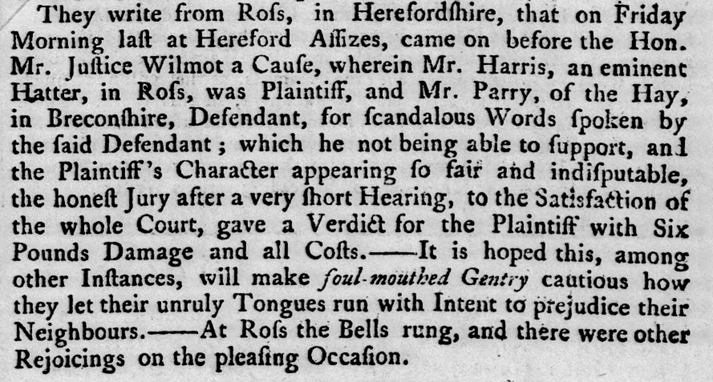
The Gloucester Journal Tuesday 23rd March 1762.
1765
At the March Assizes the following prisoners were tried: William Brace for stealing grain in the straw from Joseph Gardener. Thomas Winter on suspicion of sheep stealing. James Scull and John Little or Lewis for a burglary. John Prosser for stealing a pig, the property of the Rev. Cooke. Mary Howard for the murder of her bastard child. Mary was committed to the County gaol in November 1764, she had concealed the infant in a draw-well. The outcome of Mary, and the other prisoners unknown.
Two men were capitally convicted and condemned: John Hunt for stealing gears for horses and William Cooke for sheep stealing. Both men were afterwards reprieved and ordered to be transported beyond the seas for a term of 14 years.
Jane Price for receiving stolen malt was ordered to be transported for seven years. John Pitt for stealing the said malt was sent down to six months imprisonment. John Thomas for stealing cheese to be whipped and imprisoned for six months.
At the summer assizes in August, Philip Vaughan for breaking open the house of Mr. Ireland and stealing 24 half-crowns and Thomas Williams for stealing a gown from Ann Williams, were capitally convicted and received sentences of death; both were later reprieved and ordered to be transported for 14 years. William Dunn for stealing linen cloth was transported for seven years.
1766
At the March Assizes: David Williams and William Barrell were ordered to be transported for seven years.
Three were burnt in the hand and four were acquitted.
At Hereford Assizes a remarkable trial was brought on before Baron Perrot, wherein John Davy, a soldier in Lord Waldegrave’s regiment, was plaintiff, and a Quarter-master and Clerk to a troop in the said regiment defendant. -
The case was this: While this regiment lay in Germany, his Lordship gave a pair of garters to each of his men: The defendant having the distribution of them, delivered out the same accordingly, but without mentioning them as his Lordship’s gift, and charged his troop 2s., a pair, appropriating the money to his own use. When the regiment returned to England, the men found they had been wronged, but none dared to complain, fearing the displeasure of their Officers; till about two years ago, whilst they were quartered at Hereford, this man asked the said Quarter-master to return the money he had so unjustly exacted from him; who being enraged, ordered him into confinement, and three days after held a mock Court-martial of two or three inferior Officers, who sentenced him to receive 200 lashes, one half of which were severely inflicted on him; but the gentlemen of Hereford, hearing the story, generously interposed with the commanding Officers, and got his sentence mitigated to drumming out of the regiment. Upon hearing the evidence, the jury gave their verdict for the plaintiff, with £100, and costs of suit.

The Leeds Intelligencer 1st April 1766.
Create Your Own Website With Webador