Herefordshire CRIME & PUNISHMENT WITH EIGHTY-FIVE EXECUTIONS BETWEEN 1731-1903
Executions had taken place at Gallows Tumps, in Hereford, and at St. Olave’s Street, Hereford, and from August 1796, at Hereford County Gaol, executions had taken place upon the flat roof of the entrance to the gaol.
Some doubt exists as to the precise number of criminals buried within the precincts of the prison as the relatives had the option of claiming the bodies, except in cases of murder, when they were invariably handed over for dissection.
During the War of the Roses (English Civil War) 1455-1487, fought between the House of Lancaster (Red Rose) and the House of York (White Rose) Sir Owen Tudor born c. 1400, at Anglesey in Wales, founder of the Tudor dynasty, and Great grandfather of Henry VIII. Owen a Lancastrian was after the defeat at the Battle of Mortimer’s Cross, at Kingsland in Herefordshire, on the 2nd of February 1461, beheaded. He was buried at Greyfriars Church, in Hereford.
John Kemble, born circa 1599 at St. Weonards in Herefordshire, was an English Catholic priest. The Crown sentenced him to be hanged, drawn, and quartered for his preaching. Kemble was executed on the 22nd of August 1679, at Widemarsh Common in Hereford. Notably, he was permitted to die before the customary procedure of drawing and quartering was carried out.
Before the transportation Act of 1717/18 (The Piracy Act 1717) most criminals were either whipped, branded, or sentenced to death. Long terms of imprisonment were virtually unheard-of.
From May 1718, up to the start of the War of Independence in April 1775, an estimated 50,000, British criminals were transported, who on arrival were sold into slavery.
Between 1775-1787, convicts sentenced to transportation remained in over-crowned gaols, until the introduction of Prison Hulks (Derelict decommissioned warships) moored mainly in the River Thames, and offshore waters like Plymouth and Bristol. The convicts were sent to hard labour during the day and lived in barbarous, disease-ridden and deadly conditions on the Prison Hulks.
During this time some convicts were transported to Africa. On the 13th of May 1787, the first Fleet set sail from Portsmouth, arriving at Sydney Cove, New South Wales, Australia, in January 1788.
THE 1730'S
1732
At the March Assizes 1731/32, two men were condemned to death: J. Jones for stealing several sums of money from his master; Robert Weaver for the robbery and barbarous murder of Thomas Matthews a bailiff, to Mr. Monington, in the parish of Webley. Jones was later reprieved. Two persons were burnt in the hand and eight were ordered to be whipped.
- Robert Weaver was executed on the 27th of March 1731/32, he was afterwards hanged in chains on White Hill.
After a few days his body was stolen off the gibbet. Weaver’s accomplice a man named William Sayfell, who confessed the fact, was admitted in evidence against Weaver.
Weaver when brought to the Bar, was very stubborn and obstinate, he refused to plead to his indictment, whereupon the Judge ordered his thumbs to be twisted with a whipcord, which he endured till they were cut to the bone, his trial was deferred on account of the absence of two witnesses. On being tried two days later it was fully proved that he fired the pistol with which Mr. Matthews was shot dead. He was thereupon found guilty and sentenced to be hanged in chains near the place where he committed the said robbery and murder. While under sentence of death he had signed a written confession of his guilt.
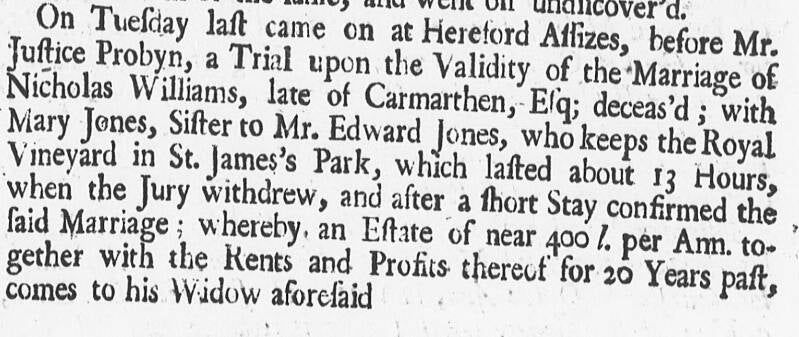
The Derby Mercury Thursday 24th August 1732.
1733
March 1733: Richard Winsmere for horse stealing; Thomas Raper for house breaking; William Wilson and William Robinson were convicted of forgery, all four were capitally convicted and left for execution. The last two men were reprieved and ordered to be transported for fourteen years.
Thomas Winter for stealing goods from a dwelling house was sentenced to seven years transportation.
Three other men were tried William Green, Thomas Jenkins with house breaking, and Walter Preece for horse stealing, the outcome of all three men is unknown.
Richard Winsmere or Wilsmere for Horse stealing and Thomas Raper for a burglary, were executed by hanging on Saturday the 24 March 1733.

The Gloucester Journal Tuesday 13th March 1732-33

The Gloucester Journal 27 March 1732/33
1. Richard Winsmore was born to honest yet mean parents; he believed his troubles began with his father's death and his mother's excessive indulgence, which allowed him to waste the small amount his father had managed to save.
He acknowledged that the principal cause was owning to the depravity of his will; in readily complying with the evil instructions he had received from the bad company he fell into.
He had also confessed that he was guilty of the crime he was to suffer for, and heartily begged pardon of God not only for that, but all other whether known or concealed. That he desired his Countrymen not to entertain an ill opinion of those whom he had wrongfully accused of being in a confederacy with him; and concluded with recommending his wife and children to the care and providence of the almighty.
2. Thomas Raper upon his own confession had said, that he was about 27 years old, that he had courted a young woman who gave birth to his child, and having so much respect for her they lived together for a considerable time as man and wife.
But the woman had set her affections upon another man, so Thomas walked away from the relationship and took to the road, upon his travel’s he had the misfortune to buy a horse from a man for 35s., who as they were riding together, informed him that he had stolen the said horse and five more beside, and returned him half his money.
There had parted company and on arriving at Gloucester, where he was arrested, committed to the County Gaol for horse stealing. While in gaol he met with Charles Winter, who persuaded him to break out of gaol with him.
After three days on the run without food, they come upon a house of Mr. Noble, in Herefordshire. Winter said that he had formerly lived there and knowing the ways of the house would go and fetch some food and drink. He brought some bread and cheese and cider, and other articles that were unknown to him. Thomas had told Winter not to meddle with anything else apart from the food and drink.
After the said robbery, the two men were pursued and taken, Winter being killed in resisting the persons who had followed them.
Summer Assizes which ended on the 17th of July 1733: John Williams for stealing out of the Mill house, of Richard Munn several garments belonging to his (Richard Mann’s) servants, was capitally convicted and received sentence of death.
John Ralph, John Saife and John Hallings all three were ordered to be transported for seven years.
Mary and Catherine Thomas were burnt in the hand. And one man was ordered to be whipped.
On Thursday the 15th of October 1733, six prisoners sentenced to transportation, were removed from Hereford gaol, under a strong guard to Bristol, to be shipped off to His Majesty’s Plantations in America.
Right: The Gloucester Journal Tuesday 7th August 1733
1734
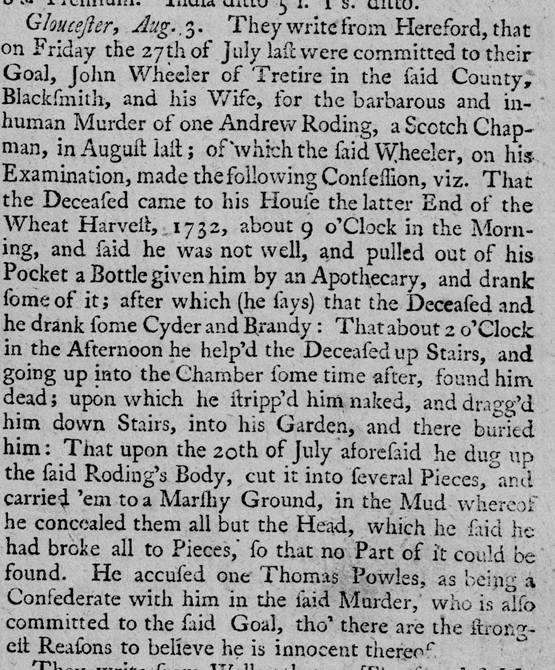
At the March Assizes, John Wheeler was condemned for the barbarous murder of Mr. Andrew Rudi or Roding a Scotchman. Wheeler’s wife, and Thomas Powles were acquitted of the said murder.
Edward Parlour was condemned for the murder of Richard West.
Mary Taylor was ordered for transportation, and Thomas Williams was burnt in the hand.
3. John Wheeler executed on Saturday the 6th of April 1734 and afterwards hanged in chains near the place where the murder was committed, at Ross, in Herefordshire.
Wheeler a blacksmith had in October 1733, tried to commit suicide by cutting his throat while in his cell at Hereford gaol. His behaviour to the last was obstinate and wicked. He confessed that he was concerned in the murder of his first wife and that he strangled his own child, which he said had smiled at him while he was dying.
4. Edward Parlour for the murder of Richard West, executed in April 1734, he behaved quite contrary to Wheeler, showing great signs of sorrow and repentance.
1736
At the August Assizes, John Taylor was condemned for horse stealing but afterwards reprieved and left for transportation; William Jones for stealing was ordered to be transported for seven years; John and Elizabeth Palmer, Francis Baylis and Benjamin Bach were ordered to be whipped for stealing wheat.
1737
Two men were condemned to death at the March Assizes, William Sutor with uxoricide and John Griffiths for a burglary. Griffiths was later reprieved and transported.
5. William Sutor executed on Saturday the 2nd of April 1737, for uxoricide (the murder of one’s wife.) Sutor had confessed to the fact that he killed his wife Catherine, but said he did not do it deliberately, being provoked thereto in his passion, he acknowledged himself to be a very heinous sinner and deserving in death. He forgave everybody and prayed to God to forgive him, and to all outward appearance was very penitent. He was so illiterate before his condemnation that he could not say the Lord’s-prayer.
Thomas Hughes was sentence to death for horse stealing, at the Summer Assizes in August, but afterwards reprieved.
John Done and Robert Matthews were ordered for transportation. Four over convicts were ordered to be whipped.
Walter Evans was fined three marks and a year’s imprisonment, for an assault with intent to ravish one Joan Grub a woman near 60-year of age.
1738
At the Lent Assizes held in March fourteen persons were tried. Four were condemned to death, eight were sentence to transportation and two were ordered to be whipped. Two were afterwards reprieved. William Summers and John Tippin were executed on Saturday the 25th of March 1738:
6. William Summers for house breaking.
7. John Tippin for house breaking. They behaved in a very penitent manner but made no confession. At the tree the hangman was intoxicated and believing there were three persons ordered for execution, he tried to put one of the ropes about the parson’s neck as he stood in the cart and with much difficulty, he was prevented by the gaoler from doing so.
At the summer assizes in August, two individuals were sentenced to death: Joseph Babington for horse theft and Thomas Reece for the theft of a gold ring and other items. It remains unclear whether Joseph Babington and Thomas Reece received reprieves or were executed.
THE 1740'S
1740
At the March Assizes in 1740 Richard Price and Joseph Hawkins were capitally convicted and received sentenced of death for house breaking, on consideration of their youth the Judge reprieved them.
Four prisoners were transported, and one ordered to be whipped.
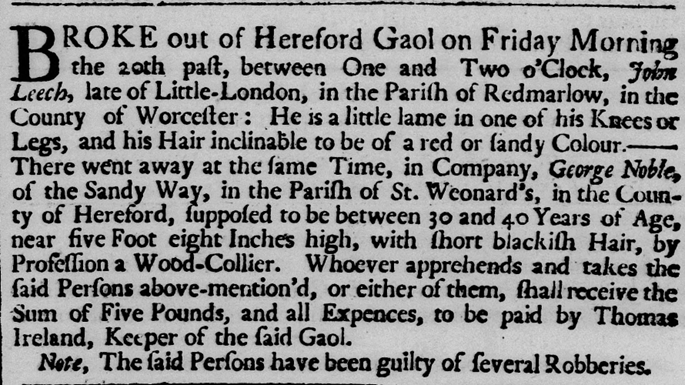
In July 1740, John Morgan was sentenced to death for being at large; however, it is unclear whether his sentence was commuted or carried out.
The Gloucester Journal 1st July 1740.
1741
John Summers was condemned to death in March, outcome unknown, it’s believed he had been transported along with four others who were also condemned to death.
Four men were capitally convicted and condemned to death, at the assizes in July: John Williams for horse stealing; Anthony Matthews for house breaking; James Collins and John Mason for sheep stealing.
Collins and Mason being were reprieved. The outcome for Williams and Matthews remains unknown.
1742
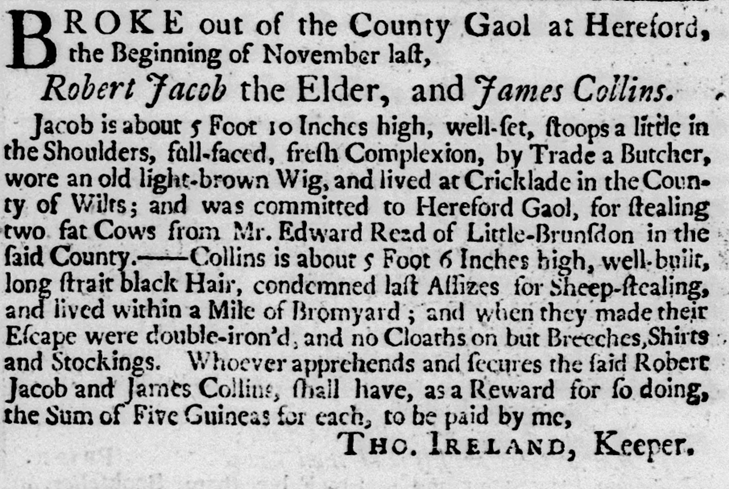
In January 1742, James Collins and Robert Jacob the elder, escaped from the County Gaol at Hereford. Collins who was condemned for sheep stealing in July 1741, was 5 foot 6 inches, well-built with long straight black hair, he lived within a mile of Bromyard.
Jacob was about 5 foot 10 inches tall, and well-set, full face with a fresh complexion, and an old light-brown wig, by trade a butcher, he lived at Cricklade in the County of Wiltshire, he was committed to Hereford Gaol for stealing two fat cows from Mr. Edward Read of Little Brunsdon.
When they made their escape, they were double-ironed, wearing only breeches, shirts and stockings. Thomas Ireland, Keeper of the Gaol, offered five guineas per man as a reward.
The Gloucester Journal Tuesday 26th January 1741/2
At the March Assizes: John Stevens was capitally convicted and received sentence of death, for sheep stealing. Outcome unknown.
1743
Thomas Perry was condemned at the March Assizes, for being at large, maybe the same man as Thomas Reece who was condemned and later reprieved in August 1738, for stealing a gold ring.
Three prisoners were condemned to death in August, and afterwards reprieved. Thomas Davies for horse stealing; Thomas Pendro for sheep stealing; and Edward White or Whitefoot.
Thomas Davies and Edward White were reprieved and ordered to be transported for 14 years.
Outcome of Thomas Pendro unknown.
1744
At the March Assizes, William Jones was burnt in the hand for stealing pigs. Elizabeth Manning was ordered to be whipped.
Thomas Newton was capitally convicted at the summer assizes in July and received sentence of death for uxoricide. Newton was a no good, wife beating “son of a bitch.” He had within a few years three wives, and was violent, cruel and barbarous to each of them. Newton lived in the parish of Bodenham. His third wife Joan was found dead in the River Lugg, her skull was fractured, her arm was broken and she had several marks of violence around her body.
There are no available records regarding his execution or any possible reprieve; thus, the outcome remains uncertain.
1746
Mary Bullock was capitally convicted at the March assizes, for stealing a horse, another two unnamed persons were also condemned, all three were reprieved.
Three prisoners were condemned to death, at the summer assizes in August but were all reprieved, George Rainforth for burglary, William Floyd and Thomas Pantall for sheep stealing.
1748
On the 15th of March, the assizes ended, when two persons received sentence of death, Anthony Baynham for sheep stealing and John Aspey for stealing a cow, both were afterwards reprieved.
1749
Four persons were capitally convicted and received sentence of death, at the March Assizes: William Hooper and Thomas Gilbert for sheep stealing. John Morris for horse stealing and Mary Monk for setting fire to the house of James Gittus in the Parish of Stanford Bishop.
Afterwards, Morris was left for execution, Hopper and Gilbert were reprieved. But the outcome of Mary Monk is completely unknown.
8. John Morris was executed in March/April 1749, for horse stealing.
THE 1750'S
1751
Seven persons were condemned to death at the March Assizes: James Moore alias Morse, for robbing on the highway, was left for execution and hanged the following month.
Anne Havard for house breaking, was left for execution, the outcome for Anne, is unknown.
William Edwards and John Davis for horse stealing; James Lewis for sheep stealing; James Watkins for stealing goods to the value of 40s., out of a dwelling house; and Jane Jones for picking pockets were all afterwards reprieved.
Daniel Hill for uttering counterfeit money, was burnt in the hand. Four prisoners were ordered to be transported and one to be whipped.
9. James Morse alias Moore was executed in April 1751, for highway robbery.
1752
William Barrel for robbing on the highway, and Thomas Smith for sheep stealing, were capitally convicted at the March assizes and condemned to death but later reprieved and ordered to transportation for 14 years.
John Herbert was capitally convicted at the summer assizes in July, for forgery and left for execution.
10. John Herbert was executed in August 1752, for forgery.
Right: The Gloucester Journal Tuesday 7th April 1752

1753
At the March Assizes three persons received sentence of death: Thomas Tyler for sheep stealing; Joseph Woodhill for a burglary; and Jacob alias John Jones for house breaking.
Joseph Woodhill and John Jones were left for execution. Thomas Tyler was afterwards reprieved. Five were ordered to be transported for seven years and one to be whipped.
11. Joseph Woodhill executed in April 1753, for burglary.
12. Jacob Jones executed in April 1753, for housebreaking.
Two men were capitally convicted and condemned to death for sheep stealing, at the summer assizes in August: William Postern alias Poston and Thomas Batch alias Back. Both were afterwards reprieved and ordered to be transported.
1754
At the March Assizes three prisoners were capitally convicted and were condemned to death: Elizabeth Williams for shoplifting; Thomas Preece for sheep stealing; and Elizabeth Hughes for horse stealing
Elizabeth Williams was left for execution; Thomas Preece and Elizabeth Hughes were reprieved; Elizabeth was ordered to be transported for 14 years. Thomas sentence is unknown.
13. Elizabeth Williams was executed in April 1754 for stealing from a shop.
James Dean alias James James, for house breaking and Thomas Davis for horse stealing were condemned and later reprieved at the summer assizes in August. Both men had escaped out of gaol on the 19th of October 1754, Dean enlisted in the Guise’s Regiment of Foot, and when apprehended he was committed to Worcester Gaol, as a deserted, he was afterwards return to Hereford Gaol.
1755
At the Lent Assizes, Thomas Webb was capitally convicted and received sentence of death. One was transported for 14 years, two to seven years and four others were acquitted.
14. Thomas Webb was executed on the 9th of April, for house breaking.
1756
Four men were condemned to death, at the March Assizes: William Morgan; Robert Fern; Thomas Watts for house breaking; and Richard Greenow for stealing two guineas and half-crown.
Morgan and Fern were left for execution; Greenow was afterwards reprieved. The outcome for Thomas Watts remains unknown.
15. William Morgan executed in April 1756, for horse stealing a bay-mare.
16. Robert Fern was executed in April 1756, for highway robbery.
Thomas Griffiths condemned at the summer assizes, was later reprieved and transported for fourteen years.
1757
At the March Assizes: John Barnet, John Baker and Henry Fisher for stealing grain, and Thomas Powell alias Howell for sheep stealing, were ordered to be transported for seven years. Two were burnt in the hand and one ordered to be whipped.
At the summer assizes in August: Four persons were capitally convicted, Henry Parry; Ann Warr for house breaking and stealing therein money and clothes; David Matthews for stealing bushels of barley; and James Willett for highway robbery.
Only Parry was left for execution. The outcome of Warr, Matthews, and Willett remain unknown.
17. Henry Parry was executed in August 1757, for sheep stealing.
1758
At the March Assizes: Catherine Sayce was acquitted of infanticide (murdering her bastard child.) Edward Parsons was capitally convicted and condemned to death for stealing a fat wether sheep, afterwards reprieved on condition that he be transported beyond the seas for 14 years. Henry Mason was convicted for stealing two pigs, outcome unknown. Thomas Rudge was convicted of stealing rings, money and other articles, and ordered to be transported for seven years.
At the July Assizes: Thomas Reed for stealing £8., in cash out of a gentleman’s house where he had lived, received sentence of death and afterwards reprieved. Ann Ware (who may well be the said Ann Warr condemned the previous year) and Joan Lewis for several felonies were ordered to be transported for 14 years.
Thomas Lewis and James Pritchard were transported for seven years.
1759
At the April Assizes three persons received sentence of death: William Jones for sacrilege; Thomas Veal for sheep stealing; and Ann Prosser for house breaking. Jones was left for execution; Thomas Veal and Ann Prosser were later reprieved and ordered to be transported for 14 years.
John Hackford, Jane Davis and James Wellington for several felonies were ordered to be transported for seven years; James Davie who was condemned five years previously was ordered to be transported for life. one was sentenced to be whipped. Twelve were acquitted. John Weaver was detected in picking the pockets of several gentlemen whilst in the Court. A great number of handkerchiefs and gloves were found upon his person; he was later tried by the Judge and was ordered for transportation.
18. William Jones executed in April 1759, for sacrilege, robbing within the Parish Church of Hentland.
Stephen Deakin for sheep stealing was condemned to death at the summer assizes in August. He was afterwards reprieved and sentenced to fourteen years transportation.
the 1760's
1760
At the March Assizes four persons were capitally convicted and received sentences of death: Sarah Wakefield for stealing a cow; Evan Philips for stealing three pounds seven shillings, from a dwelling house; Walter Walkins and Richard Pitt for sheep stealing. All four were afterwards reprieved.
Benjamin Williams, John Pritchard, Phoebe Bromage, and Susannah Owens, for felonies were ordered to be transported for seven years.
1762
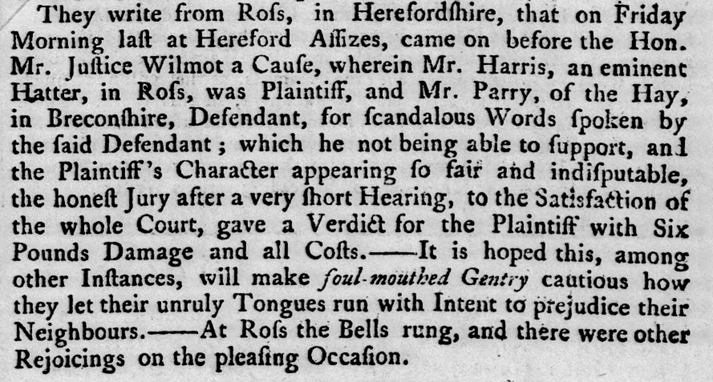
Richard Loton was capitally convicted at the March Assizes, of stealing fifteen guineas out of the house of Edward Williams and condemned to be hanged.
John Lewis for stealing three beehives; Thomas Miles for highway robbery; and Mary Ellis for taking £60., out of the house of Walter Hill, were ordered to be transported for seven years.
Margaret Price was burnt in the hand and nine persons were acquitted.
The Gloucester Journal Tuesday 23rd March 1762.
1765
At the March Assizes the following prisoners were tried: William Brace for stealing grain in the straw from Joseph Gardener. Thomas Winter on suspicion of sheep stealing. James Scull and John Little or Lewis for a burglary. John Prosser for stealing a pig, the property of the Rev. Cooke. Mary Howard for the murder of her bastard child. Mary was committed to the County gaol in November 1764, she had concealed the infant in a draw-well. The outcome of Mary, and the other prisoners unknown.
Two men were capitally convicted and condemned: John Hunt for stealing gears for horses and William Cooke for sheep stealing. Both men were afterwards reprieved and ordered to be transported beyond the seas for a term of 14 years.
Jane Price for receiving stolen malt was ordered to be transported for seven years. John Pitt for stealing the said malt was sent down to six months imprisonment. John Thomas for stealing cheese to be whipped and imprisoned for six months.
At the summer assizes in August, Philip Vaughan for breaking open the house of Mr. Ireland and stealing 24 half-crowns and Thomas Williams for stealing a gown from Ann Williams, were capitally convicted and received sentences of death; both were later reprieved and ordered to be transported for 14 years. William Dunn for stealing linen cloth was transported for seven years.
1766
At the March Assizes: David Williams and William Barrell were ordered to be transported for seven years.
Three were burnt in the hand and four were acquitted.
At Hereford Assizes a remarkable trial was brought on before Baron Perrot, wherein John Davy, a soldier in Lord Waldegrave’s regiment, was plaintiff, and a Quarter-master and Clerk to a troop in the said regiment defendant. -
The case was this: While this regiment lay in Germany, his Lordship gave a pair of garters to each of his men: The defendant having the distribution of them, delivered out the same accordingly, but without mentioning them as his Lordship’s gift, and charged his troop 2s., a pair, appropriating the money to his own use. When the regiment returned to England, the men found they had been wronged, but none dared to complain, fearing the displeasure of their Officers; till about two years ago, whilst they were quartered at Hereford, this man asked the said Quarter-master to return the money he had so unjustly exacted from him; who being enraged, ordered him into confinement, and three days after held a mock Court-martial of two or three inferior Officers, who sentenced him to receive 200 lashes, one half of which were severely inflicted on him; but the gentlemen of Hereford, hearing the story, generously interposed with the commanding Officers, and got his sentence mitigated to drumming out of the regiment. Upon hearing the evidence, the jury gave their verdict for the plaintiff, with £100, and costs of suit.

The Leeds Intelligencer 1st April 1766.
1767
At the March Assizes seven prisoners were condemned to death: John Pugh; Thomas Lloyd for sending a threatening letter to Edward Salway demanding a hundred guineas to be put in a certain place; John Watkins for stealing an Ox; Thomas Smith and John Jones for burglaries; Henry Griffiths for committing a rape upon Ann Voice; and John Hunt for being at large. Pugh and Hunt were left for execution. The outcome of the other five are unknown.
19. John Pugh was executed on Saturday the 18th of April 1767, for entering the house of John Lawrence with intent to steal and with cutting the throat of Susannah Lawrence with a penknife.
20. John Hunt executed on Saturday the 18th of April 1767, for being at large (returning from transportation.) See also John Hunt 1766.
At the summer assizes, three persons were capitally convicted: Frances Francis for stealing clothes and money from a Mr. Wall; John Suffolk for uttering a forged bill with intent to defraud William Trott; and James Pritchard for sheep stealing. The outcome of all three are unknown.
1768
At the summer assizes held in August, Thomas Mayrick for a burglary and Matthew Brewton for a theft were capitally convicted and received sentence of death.
1769
At the assizes in August, three persons were capitally convicted: Richard Brazier for stealing 42 sheep, he had sold ten to Thomas Abell of Egleton in the parish of Bishop’s-Froom in Herefordshire at 5s 6d., each; Ann Jones for housebreaking; and William Price for stealing a ram were all condemned to death. The outcome of the three condemned prisoners is unknown.
George Voice, for assisting five prisoners in attempting to escape out of gaol was ordered to be transported for seven years.
the 1770's
1770
Murder of William Powell on the 8th of January 1770:
30th March 1770, six Welshmen were executed for the murder of William Powell. Nine men were tried, but three were acquitted. The names of the condemned were:
21. William Spiggott, barber.
22.William Walter Evan, thinker.
23. William Morris, saddler.
24. David Morgan, tinker.
25. David Llewellyn, farmer.
26. Charles David Morgan, farmer.
It seems that the men had all rushed into the parlour of William Powell’s house, at Glanhereth, Carmarthenshire, where the old gentleman was sitting in his chair; their faces were blackened and their persons disguised and with swords and cutlasses inflicted over 12 stabs wounds, seven of which were mortal.
They were all removed to Hereford Gaol and hung at Gallows Tumps, a mile from the city. At about midday on Friday the 30th of March 1770, the convicts were conveyed to the pace of execution by the Sheriff and turned off at half-past one, Morris was in a fit and quite insensible before he came to the gallows, where he was held up whilst the noose was place round his neck. Spiggott begged earnestly to be buried in a Churchyard. The other appeared penitent and resigned. David Morgan addressed the spectators in Welch, desiring them to take warning by this fate, and not suffer wicked men to lead them to villainy.
The bodies of William Spiggott and William Walter Evan were taken and hung in chains upon Hardwick Common near Hay. The other four were dissected.
August Assizes 1770, Edward Jones for a burglary and James Trotter for horse stealing were condemned to death but afterwards reprieved; Elizabeth Craddock, for receiving stolen goods was ordered to be transported for 14 years; Thomas Hill for stealing clothes and Thomas Bowles for stealing money was ordered to transportation for seven years; Richard Craddock for stealing money was burnt in the hand; John Gwillim for stealing clothes was ordered to be whipped.
Elizabeth Jones who was concerned with her husband the said Edward Jones was acquitted.
Martha Oakley was acquitted of the murder of her bastard child.
1771
At the August Assizes: Thomas Jenkins was capitally convicted for horse stealing received sentence of death; he was afterwards reprieved. James Downes for stealing silver spoons was transported for seven years.
John Woodhouse, James Symonds and Thomas Proffer were burnt in the hand; Anne Taylor was imprisoned for one month.
1772
At the March Assizes: Thomas Paling was condemned for stealing a black gelding, his brother John was acquitted. John Spraggs charged with stealing cider was acquitted, as was John Gritton and Iron Speaks. John Foz for breaking into a barn and stealing cider, was found guilty of petty larceny; and Anthony Bird for having stolen a pair of silver shoe buckles and other articles, was found guilty of grand larceny.
1773
March Assizes 1773, John Medlicot for highway robbery; Samuel Williams for house breaking; Luke Davis for horse stealing; and John Frere for the wilful murder of Mary Robinson., were all condemned to death. Luke Davis was afterwards reprieved.
In the case of John Frere. Mary Robinson, a girl who had been for a short time a servant of Frere. It appeared in evidence that he had on Monday the 23rd of November 1772, in his workshop in a back lane in the city of Hereford, tried it on with her in a most violent manner, on her resisting he threw her down on a heap of leather and notwithstanding her continual struggles kept her down with her legs over his shoulders for some time, he later let her go. Mary was an orphan and had nowhere to go, so she stayed with her master, but by Sunday the 29th of November, Mary being in too much pain and ill from the beaten she had taken form Frere, was turned out of her master house as she was incapable doing her work.
Mary had no money and nowhere to go, she was also very ill, she was taken in by the wife of Mr Symonds a butcher of Hereford. The next day she was allowed back at Frere house and was put to bed and taken care of. A fever which had attacked her soon after the assault was now high upon her, she was very weak and a couple of day later become delirious, on the 10th of December she died of a putrid fever, having been attended for only the last two days by an apothecary.
On the part of the defence, it was said that after she received the injuries on the 23rd of November, she was at work in her master’s workshop as usual and that she was cheerful and made no complaints, and that she on the 27th of November visited a neighbour who had a fever. The jury after leaving the court for about half an hour returned a verdict of guilty. No record of Frere execution can be found so no doubt he had been reprieved.
27. John Medlicott was executed the 3rd day of April 1773, for highway robber, near Ludlow, upon Caleb Stedman.He confe ssed that he had discharged a pistol at a man with intent to murder and rob him. He had also confessed to stopping Mr. Reynolds a farmer on the Turnpike Road, between Tenbury and Ludlow, who he shot in the face, because he refused to hand over his money.
On Saturday the 19th of December 1772, at Ludlow, John Medlicott a labourer was brought before the Rev. John Holland and Somerset Davies, two of his Majesty’s Justice of the Peace, on a strong suspicion of being the man who had assaulted Sarah Andrews, on Monday the 7th of December, in the morning; also with stopping, firing at and wounding Mr. Reynolds the same morning. The young woman refused to swear to the identity of his person, as the darkness of the morning prevented her observing any particulars of him to be the man who had stopped her. He was discovered by a pistol being found loaded with a slug, which was taken to a gunsmith in Ludlow, who deposed that he had sold the pistol to the prisoner about a year ago. He was committed to prison for further examination until Mr. Reynolds could be sent for. In the meantime, Mr. Stedman a farmer of Coxall stated that he had been stopped at Mogtree in Herefordshire, last February and was robbed of some money, amongst which were a crown piece and some remarkable half-pence pieces, had a strong suspicion that the prisoner was the person who had robbed him. A publican who had changed the crown piece and received the halfpence appeared and positively identified the prisoner to be the man from whom he received the said money.
28. Samuel Williams executed the 3rd of April 1773, for house breaking. Samuel Williams had broken open two dwelling houses one belonging to Mr. W. Day at Collard and one belonging to William Miles at Canon Froome and stealing therein clothes from each house. He confused that he had robbed Mr. Mellin of £7., a butcher of Credenhill two or three years previously. While under sentence of death both Medlicott and Williams attempted to escape form Hereford Gaol.
At the August Assizes four men were capitally convicted and receive sentence of death: Thomas Hatten and John Tayler for horse stealing; Edward Millichap for sheep stealing; and Samuel Jones for house breaking.
Benjamin David, John Thomas and Samuel Jones were ordered to be transported for 7 years.
Joseph Owen was indicted with matricide the wilful murder of his mother, who had been a most tender and affectionate parent to him. In the morning of the 26th of May, after the father had left the house, the only persons present thereafter were his wife and 13-year-old daughter. Joseph walked into the house with a spade and hit his mother twice over the head. Mrs. Owen died instantly from a fractured skull. During the trial it become obvious that Joseph was and had been insane for some time. The jury acquitted him of the charge of murder, but proper directions were given to secure him and to prevent other fatal effects of his phrenzy.
1774
March Assizes 1774, four persons received sentence of death, all were reprieved except one Samuel Aymiss. David Hughes alias Morris and Thomas Saunders for sheep stealing; Mary Jones for stealing a box with money, rings and other articles from the home of Thomas Hankins, were reprieved. Three were ordered to be transported for seven years, three were burnt in the hand and two ordered to be privately whipped.
29. Samuel Aymiss executed 2nd April 1774, for house breaking. Breaking into the house of Thomas Baylis, at Kimbolton and stealing a silk handkerchief.
His surname Aymiss is more than likely spelt incorrectly. He confessed the Justice of his sentence but denied to the last of having stolen the handkerchief for which he was condemned.
1775
March Assizes 1775: Six prisoners were condemned to death, James Parry, Thomas Parry, Charles Powell, and Thomas Gummer for pulling down and destroying the Corn mills of John Parry of Kings land; Robert Harris for stealing clothes and other articles the property of Thomas Bevan; William Rees for stealing and driving away two Oxen the property of James Davies, they were all afterwards reprieved except James Parry who was left for execution.
1776
March Assizes 1776: William Williams for housebreaking was burnt in the hand and committed to the house of correction for 18 months; Morris Williams for stealing a cheese and other articles and Ann Adams for stealing clothes were ordered to be publicly whipped and imprisoned for one month.
1777
July Assizes 1777: William Phillips convicted of sheep stealing; and Charles Williams for house breaking were capitally convicted, Phillips was afterwards reprieved. James William for stealing a watch was sentence to hard labour on the Thames; Sarah Isaac and Ann Hodnett, for theft were ordered to be imprisoned; John Hayward for shooting at John Wood was ordered to be imprisoned for 18 months.
30. Charles Williams executed 2nd August 1777, for breaking open the house of Mr. George Winton or Winter, of the “Perry” at Stoke Bliss. Williams had stolen several articles. But believing that he was going to find some money in a bureau that stood in one of the rooms, and upon finding no money within the bureau he set it alight, the fire doing some serious damage.
1778
August Assizes 1778: David Davis was sentenced to be hanged, and his body dissected and anatomized, for murder. Robert Powell and William Preece, for horse stealing received sentence of death but afterwards reprieved, Richard Jones for stealing linen was ordered to be kept to hard labour on the River Thames for three years. Sarah Isaac for stealing linen to be kept to hard labour in the house of correction for two years. Robert Price, for stealing wheat and Samuel Turner for stealing linen one year’s hard labour in the house of correction. Richard Preece for an assault with intent to murder, was fined 5s., which was paid to the Sheriff in Court and he was discharged.
Elizabeth Price with stealing linen; Jane Price and Elizabeth Allenwith with sheep stealing; Francis Simister, charged with a rape; Thomas Watts with horse stealing; and Duppa Smith with stealing wheat were all acquitted and discharged.
31. David Davis was executed 20th August 1778, for the murder of a female child, named Owens, alias Flyde at Staunton-upon-Wye. His behaviour on his way to the gallows was decent, but with his last breath declared himself innocent of the crime for which he suffered. Though the circumstances against him were so strong, that no reasonable doubt of his guilt can find a place in anybody’s minds.
The barbarous murder of 9-year-old Elizabeth Owens otherwise Flyde, happened in June 1777, at Staunton-upon-Wye. The jury at her inquest returned a verdict of a violent suspicion of murder by David Davis of the said Parish if Staunton-upon-Wye, believed to of fled to Wales.
Davis enlisted in the Welsh Fusiliers, on being ordered into Herefordshire with a party of that Corps, he was apprehended at Ross (due to a wanted poster) and delivered to the County Gaol.
1779
August Assizes 1779, Thomas Bury for stealing 13 ewes, 11 lambs, and a wether sheep was capitally convicted and sentenced to death. William Jennings for stealing a gate and a quantity of elm boards of the value of 5 shillings, the property of Thomas Jones; John Roper for stealing a quantity of cider, the property of Timothy Bufy; and Rachel Berrington for having stolen 5 ½ yards of printed cotton, the property of Yeates merchants of Hereford, were ordered to be whipped with six months’ imprisonment.
John Jones, Joseph & Richard Scribbings, Malachia Jones, and Paul Jones were discharged.
James Evans and James Davies were acquitted.
the 1780's
1780
August Assizes 1780: George Morris was capitally convicted of stealing a gelding and condemned to death.
1782
July Assizes 1782, Thomas Griffin for sheep stealing; Mary White for burglary; Ann Evans for house breaking; John Webb and William Harry for plundering a Venetian ship, wrecked on the Glamorgan coast, in December 1781, were all capitally convicted and received sentence of death, but afterwards all were reprieved except Webb who was left for execution. David Llewellin for robbing a wagon of goods saved out of the wreck of the Venetian ship was transported to the Coast of Africa for seven years.
32. John Webb was executed 7th September 1782, for the act of plundering a vessel along the coast of Glamorganshire.
1783
March Assizes 1783: Eustace Lane was condemned along with seven others; Thomas Jones, William Melling, Jane and Elizabeth Preece for sheep stealing; John Price, Hannah Tomkins and Mary Dobbs for breaking into houses and stealing clothes and other articles. Only Lane was executed the others being reprieved.
George Enns for stealing gold rings and other goods out of the shop belonging to Benjamin Johnson was ordered to the Thames for three years; Benjamin Leek for stealing bacon, a pillowcase, and a quantity of flour, the property of Thomas Budd, to be confined in the House of Correction for two years; Mary Jones for stealing clothes the property of Anne Hennan to be confined in the House of Correction for two months. Seventeen prisoners were acquitted.
33. Eustace Lane was executed 9th April 1783, for horse and sheep stealing. Eustace Lane was born in 1741, and Baptist on the 12th of April 1741, at Bredenbury in Herefordshire, the son of Francis and Anne. He had been admitted to bail on a charge of stealing sheep at Bodenham and while on bail he stole a horse belonging to Mr. Inett, of Collington, when he was again committed.
1784
March Assizes 1784; 16 criminals were capitally convicted John Nicholls with assault and robbery; George Woodhouse and Abraham Ankridge for burglary; James Harris for burglary; Thomas Watkins for burglary; and Christopher Carter for two burglaries, were all left for execution. James Haynes aged 18 for a burglary; John Hursk aged 24 and John Whatmore aged 21 for a burglary; Ann Evans aged 35 for theft; Henry Joiner aged 12 for a burglary; John Camm aged 26 for house breaking; Thomas Williams aged 23 for sheep stealing; John Ross aged 44 and Margaret Payne aged 21 for house breaking; and William Powell for horse stealing were all reprieved.
Francis Nott aged 17 for a burglary was ordered to be transported, Ann Webb aged 32, Elizabeth Powell aged 19 and Thomas Pounds aged 23 were sentenced to imprisonment in the House of Correction.
Henry Joiner who was only 12, when condemned for robbing his master Mr. John Norman, only served six months in the house of correction. But Joiner did not learn his lesson, for he was committed to Worcester Gaol for breaking open the house of Thomas Bishop of Shelsey and stealing two pieces of flowered cotton in December 1786. On the 21st of July 1787, he was again condemned to death but later reprieved and ordered to be transported for seven years to New South Wales. He was transported on broad the Neptune, Scarborough and Surprise, ship which departed from the River Thames in London, on the 30th of November 1789, he arrived in New South Wales the 26th of June 1790. Joiner died at Pitt Town, in New South Wales in 1839.
The six condemned men Nicholls, Woodhouse, Ankridge, Carter, Harris, and Watkins were executed on the 2nd of April 1784:
34. John Nicholls aged 20, was executed for assaulting with a fire shovel, Mary Thomas, mistress of the Kite’s Nest public house, at Stretton Sugwas, and robbing her of £4 in silver and five silver spoons.
35. George Woodhouse aged 23, was executed for a burglary, having entered in the night the dwelling house of John Ford or Floyd at New Radnor, and stealing fourteen shillings, a bunch of keys and a pair of buckles.
36. Abraham Ankridge aged 23, executed for being an accomplice in the above robbery.
37. Christopher Carter aged 50, was executed for two burglaries in the night, one at Ross and stealing clothes, a waistcoat, a towel and a pair of shoes, belonging to Thomas Bellamy, the other at St. Weonard’s and stealing a wallet belonging to William Phillpots.
38. James Harris alias Lewis and Hancock aged 19, was executed for stealing seventeen sheep, twelve ewe, four wethers and a tup, from Mr. John Matthews at Clehonger.
39. Thomas Watkins alias Hardwick aged just 17 years, was executed for housebreaking at Lugwardine and stealing £40 from Robert Jauncey a butcher.
August Assizes 1784; James Williams with horse stealing; Elizabeth Wright for burglary; John Whitcombe for stealing a cow; John Peake for stealing clothes; John Porter for stealing a lamb; William Harris for stealing a wether sheep; and Mary Davies who committed a burglary with Elizabeth Wright, were all condemned. The first two were left for execution, the others were reprieved.
Williams and Wright were executed on the 13th of August 1784,:
40. James Williams alias Samuel James aged 74. Executed for stealing a horse from Mr. Dobson at Weston-under-Penyard. He had also committed a felony at Hope Mansell.
41. Elizabeth Wright aged 49, was executed for a burglary at Bodenham and stealing the head of a clock, two loaves a gammon, and some bacon, belonging to Thomas Weaver.
1785
March Assizes ending on the 17th, when ten prisoners were capitally convicted: William Evans, and Richard Stephens for house-breaking; John Baker aged 41, for breaking open the dwelling house of Richard White and stealing therein several articles of clothing; William Jones stealing live-stock; Richard Cartwright, John Davies and Roger Francis Sheward for sheep stealing; William Jelf for stealing shirts; John Watts aged 22 and John Hill aged 28, for obtaining under false pretences a brown mare, the property of John Hall, and a silver watch belonging to Thomas Griffiths. Evans alias Hall, Baker, Jones, Stephen and Jelf were left for execution, the other five being reprieved. No record of Baker’s execution can be found, so outcome unknown.
John Hill was tried on the 17th of March 1785 for obtaining under false pretences, a brown mare belonging to John Hall and a silver watch, the property of Thomas Griffiths. He was found guilty and condemned to death, he was afterwards reprieved and sentence to 14 years' transportation.
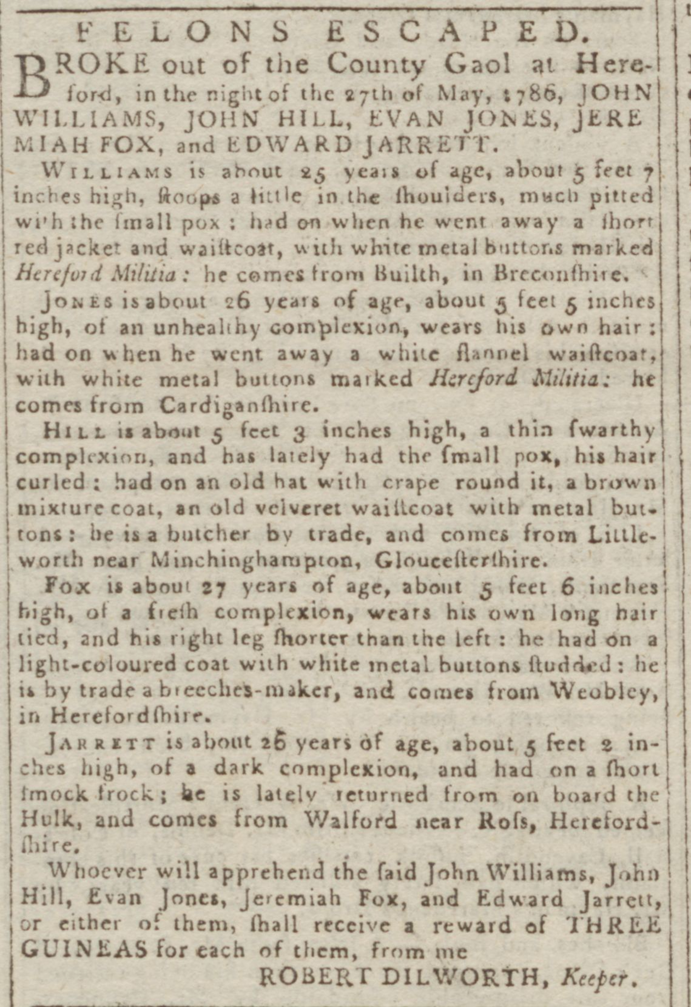
Hill had escaped from Hereford County Gaol twice, once on 26th of February and again on the 27th of May 1786. On the first occasion he was recaptured, nearly frozen to death, near his birthplace at Minchinhampton, in Gloucestershire. The second time he escapes it was with four other convicts. He was described as 5 feet 3 inches high, a thin swarthy complexion, and has lately had the smallpox, his hair curled, had on an old hat with crape round it, a brown mixture coat, an old velveret waistcoat with metal buttons, he is a butcher by trade and comes from Littleworth near Minchinhampton in Gloucestershire. How and when he was recaptured on the second occasion is not known. He was removed from Hereford gaol in August 1787 and placed on board a hulk on the River Thames. He was transported on the 29th of November 1789, on board the “Scarborough” arriving in New South Wales on the 26th of June 1790.
Richard Cartwright aged 23 for stealing a wether sheep and a hurden crib cloth, John Davies aged 60, for stealing a sheep and Roger Francis Sheward aged 42, for stealing five sheep were all condemned and later reprieved and sentenced to be transported for seven years.
Rachel Watkins aged about 21, for a burglary and stealing several articles of clothing was ordered to be transported to America for seven years. Susan Mannocks aged 11, her accomplice to be whipped in gaol and confined in Bridewell for six months.
Rachel was never sent to America but instead was transported on the “Neptune” on the 30th of November 1789, arriving in New South Wales, Australia, on the 26th of June 1789.
Mary Morris aged 18, for breaking into a dwelling house and stealing white ribbon, 12 months’ imprisonment and whipped at Kingston.
Joseph Peek aged 27, for stealing an unfinished piece of blanket, to be transported to America for seven years.
Jane Harris aged 20, for stealing a silver tablespoon, two teaspoons, a tablecloth, and an apron the property of her master, to be whipped in gaol and confined for six months.
Evans, Jones, Stephens and Jelf were executed on the 1st of April 1785:
42. William Evans alias Hall aged 18, of Gloucestershire, was condemned for housebreaking at Lugwardine and stealing clothes, a shirt, a pair of stockings, a silk handkerchief and a hat, the property of George Sheward.
43. William Jones aged 16 was executed for stealing two cows and a yearling heifer, and a bay gelding. Jones was a native of Monmouthshire and though young in years, was an old hand and skilful thief. He had escaped from Brecon gaol and while at large had stolen the cows and a horse.
44. Richard Stephens was executed for housebreaking and stealing a guinea from John Street. He was a native of Kington, and his name appears among the committals two or three times within a short period and once for robbing a Mrs. Clark, at Tillington.
45. William Lane alias Jelf was executed for stealing two hempen shirt the goods of William Vale of Middleton-on-the-Hill. Lane was a native of Gloucestershire and confessed to having broken open thirteen houses.
July Assizes 1785, four prisoners were capitally convicted and received sentence of death. John Piper and Beaumont Mace for having on the Sunday afternoon in March at about half-past three o’clock assaulted on Dinmore Hill, between Hereford and Leominster Susannah the wife of Thomas Budd a labourer of Leominster and robbed her of a pocket containing one shilling and sixpence in silver, three halfpence, a penknife, scissors and thimble; John Williams for a burglary; and Thomas Vaughan for sheep stealing only Vaughan was left for execution. The other being reprieved.
John Piper was sentenced to 12 months imprisonment and Beaumont Mace of St. Ives in Huntingdon to seven years transportation.
Solomon Woodyatt for a burglary in the dwelling house of Mr. Hartland at Ledbury and stealing five guineas, some silver, a hat, a watch case and other goods, was sentenced to seven years transportation. He was hanged on the 1st of April 1789.
Mary Williams for a burglary was ordered to be transported for seven years.
Elizabeth Evans for stealing clothes and John Lewis for picking pockets were sentence to be whipped.
John Lloyd charged with bigamy was bailed until the next Assizes.
1786
At the March Assizes nine prisoners were capitally convicted: Timothy Weaver, Thomas Yeates, William Collins, Jeremiah Fox, William Medlicot, and Evan Jones for house breaking; William Blount otherwise Brunt and Charles Powell for highway robbery; and Edward Jarrett for sheep stealing.
Weaver, Collins, Yeates, were left for execution, The other six being reprieved. Fox, Medlicott, Jones, Powell, and Blount otherwise Brunt were all ordered to be transported for life. Edward Jarrett was ordered to being kept to hard labour in the house of correction for six months.
William Blount alias Brunt was condemned on the 23rd of March 1786, for picking pockets, he was afterwards reprieved and sentenced to transportation for life. Removed from Hereford gaol in August 1787 and placed on board a hulk on the River Thames. Transported on the 29th of November 1789, arrived in New South Wales on board the “Neptune” the 26th of June 1790.
William Medlicott condemned on the 23rd of March 1786, for a burglary, reprieved and transported for life. Removed from Hereford gaol in August 1787 and placed on board a hulk on the River Thames. Transported on the 29th of November 1789, arrived in New South Wales on board the “Neptune” the 26th of June 1790.
Hereford Journal 1st June 1786
Wiliam Davies, Richard Davies, John Jarrett and John Hill the younger, were ordered to be whipped. Hannah Meredith to be confined in the Bridewell for six months.
Susannah Minton for having set fire to the burn of Paul Gwatkin and stealing a box containing sundry articles judgement respited till the next assizes.
Weaver, Collins and Yeates were executed on Friday the 7th of April 1786, numbers 47-49:
46. Timothy Weaver aged between 19-24, was executed for housebreaking at Whitbourne and stealing a box containing money a coat and waistcoat, leather breeches, two shirts, two pairs of stockings, a silk handkerchief and a hat, belonging to Thomas Haines. Timothy was a native of Preston-Wynne, who was committed to the County Gaol in August 1785. On Sunday night or in the early hours of Monday morning the 23rd of May 1785, the house of John Bedford of Leinster a butcher was broken into and robbed of a light-coloured broad cloth coat, with plain plated buttons; a green silk waistcoat; a silver watch, with the letters J. B., engraves in a cypher on the inside and outside case; three guineas in gold; a quantity of silver, and a silk handkerchief. The robbery was believed to have been committed by Timothy Weaver, who was seen five miles away leading from Leominster to Worcester, with a bundle under his arm at six o’clock on Monday morning. Timothy was described as 23-years-old about 5 feet 3 inches high, born at Preston-Wynne in the County of Herefordshire. Served sometime as an apprentice to a blacksmith in Bromyard.
47. William Collins aged 22, was a native of London, he had wandered from London to Bristol, to Gloucester and Worchester where he formed a relationship with Yeates.
48. Thomas Yeates aged 17, was a native of Broad heath near Worcester. Collins and Yeates were executed for house breaking, stealing money and clothes at Docklow.
In August 1786, three prisoners were committed to Hereford Gaol, John Phillips charged upon the oath of John Fisher and Samuel Wheeler with stealing seven sheep the property of the said, John Fisher, and three sheep belonging to Samuel Wheeler.
Mary Lewis otherwise Jenkins, charged on the oath of Mary Rumsey, of the parish of Devynnog in the County of Brecon, a single-woman, with having on the 4th of August, stolen two gowns, a black petticoat, two shirts, sixteen caps, a black silk apron, two white aprons, three pair of fleeces, an India handkerchief, ruffles, a flannel petticoat, and several other articles. Mary Rumsey pursued the said Mary Lewis from place to place, till she came to the parish of Alensmore in Herefordshire, where she found in her possession several of the said goods, the property of Mary Rumsey.
Committed to Hereford gaol in August 1786, Thomas Watters charged on the oaths of George Rodway and Thomas Johns, with breaking open their several houses in the Parishes of Collwall and Caddington, and stealing three shirts, a waistcoat, and other articles their property. John Souls an accomplice in the robbery made his escape. He was described as 27-years-old, about 5 feet 4 inches, with a dark complexion, dark brown short hair, wearing a drab colour coat, white buttons, velvet waistcoat, greasy leather breeches, a rider of running horses at Gloucester in 1784. He was armed with a blunderbuss and a brace of pistols. Thomas Watters see executed 4th of April 1788.
August Assizes 1786: Susannah Minton found guilty at the last assizes for setting fire to a barn and respited till these assizes, was ordered for execution. Thomas Cox and Richard Coburn condemned for sheep stealing were afterwards reprieved.
Thomas Hodges for stealing lead to be transported for seven years.
Margaret Phillips for stealing a hat, stockings and caps, to be whipped.
Thomas Price who was deaf and dumb, was tried with the murder of Joseph Weaver, a jury was awarded to try whether he stood mute by the act of God, or out of malice, on examining two or three witnesses it was fully proved he stood mute by the visitation of God, a verdict was accordingly given and a plea of Not Guilty was recorded, Price was found guilty of manslaughter and sentence to be imprisoned for three months.
William Williams for stealing lambs’ wool to be imprisoned for one month.
John Eyles was condemned to death on Friday the 11th of August 1786, for picking the pocket, of Mr. Trumper, a substantial farmer of Weston in the parish of Pembridge.
The case of John Eyles must be a “One-off,” a singular occurrence, for he was a free man one minutes, imprisoned the next, tried convicted and under sentence of death the same evening. At about two o’clock in the afternoon, of the said day, Mr. Lane the crier of the Court, notice Eyles a stranger of Hereford, and suspecting him of being a pickpocket, he asked Mr. Wells the Marshall of the Court to keep an eye on Eyles, within a very short space of time, he had picked the pocket of Mr. Trumper, of a canvas bag containing five guineas, half-a-crown, and some shillings.
Eyles was later reprieved and committed to transportation for life. Removed from Hereford gaol in August 1787 and placed on board a hulk on the River Thames. He was transported on the 29th of November 1789, on board the “Scarborough” arriving in New South Wales on the 26th of June 1790.
49. Susannah Minton aged 17, was executed on the 16th of September 1786, for setting fire to a barn the property of Paul Gwatkin, at Kilpeck. Susannah, said to be of weak intellect was a native of Kilpeck, a servant of Gwatkin’s. Her mistress had exhibited some articles of finery in her presence, which turned out to be too much of a temptation for Susannah. She had set fire to the barn, a short distance from the house, with the intention to draw the occupant of the household to the fire, while she stole the said articles.
1787
At the March Assizes: Luke Mapp for sheep stealing, was condemned on the 22nd of March 1787, reprieved and ordered to be transported for life. Transported on the 29th of November 1789, arrived in New South Wales on board the “Neptune” the 26th of June 1790.
Edward Faulk was transported for 7 years on board the “Matilda” arriving in New South Wales, 9th July 1791.
John Corren, William Reynolds, and Thomas Powell, were transported for seven years. All were removed from Hereford gaol in August 1787 and placed on board a hulk on the River Thames.
Executed Saturday the 7th of April 1787:
50. Thomas Jones.
51. William Morris. Jones and Morris were executed for housebreaking at Brilley and stealing various articles the property of Elizabeth Prosser, also with stealing a mare belonging to John Watkins. Both men were natives of Radnorshire. Jones gave much information respecting the whereabout of several stolen horses, which were return back to the owners.
The Summer Assizes ended the 31st of July 1787: Thomas Jones, James Hughes, and Thomas Whittington were transported for 7 years.
1788
March Assizes 1788; Nine persons were capitally convicted and sentence to death, James Perks; Thomas Jauncey alias John Brown and William Francis for sheep stealing; Elizabeth Mayo for shoplifting: Sarah Edwards and Elizabeth South for stealing clothes; and Daniel and William Hughes for different felonies. Thomas Watters alias Reynolds, for being at large. Perks and Watters were left for executions; the others were reprieved. James Perks was later transported for life. Thomas Jauncey, Elizabeth South, Sarah Edwards and Elizabeth Mayo were transported for seven years, and William Francis was kept to hard labour in the house of correction for two years.
James Perks for stealing clothes, from the tenants of Mr. Bannister, a clothier, was transported for life, departing on the 31st of December 1791, arriving in New South Wales, July 1792
Elizabeth Mayo with shoplifting, stealing 15 yards of printed cotton, and Elizabeth South for stealing clothes were reprieved and sentenced to seven years transportation. Transported on the 29th of November 1789, arrived in New South Wales on board the “Neptune” the 26th of June 1790.
52. Thomas Watters or Walters alias Reynolds. Executed 4th April 1788, for returning from transportation. Thomas Watters was a native of Bromyard and had confessed to over 100 burglary and escaping from gaol twice. He was condemned at the March Assizes in 1787, for stealing six watches, but later reprieved and sentenced to transportation for fourteen years.
1789
At the March Assizes in 1789, William Hiles for stealing a mare and Solomon Woodyatt for a burglary, were left for execution.
In October 1788 Elizabeth Godwin was committed to the Hereford Gaol, on the suspicion of her stealing several articles of clothing, the property of Elizabeth Watkins and her daughter, out of their dwelling house at Pembridge in Herefordshire. Elizabeth was tried on the 17th of March 1789, of stealing clothes and left for transportation for seven years. Transported on the 29th of November 1789, arrived in New South Wales on board the “Neptune” the 26th of June 1790.
Executed Wednesday 1st April 1789, William Hiles and Solomon Woodyatt:
53. William Hiles for stealing a mare, belonging to Harley and Co., bankers of Ludlow.
54. Solomon Woodyatt alias Thomas Brickley, for a burglary at Bromyard. Solomon was a notorious thief, he had twice escaped from gaol while under sentence of transportation for different robberies, at Ledbury and elsewhere. While at large, after his first escape, he committed the burglary at Bromyard, retaken and sent back to gaol. He broke out again but was discovered concealed in a hayloft and recaptured in February 1789. Solomon was in his early 20’s, 5 foot 8 inches tall, with red hair and a fair complexion, a native of Ledbury.

Hereford Journal 20 September 1787.
In December 1787, Solomon along with Thomas Hodgets, Thomas Collyer, were committed to Stafford goal for robbing the house of Joseph Nock of Rowley a pawn broker. Joseph Shelcock a publican was committed to the same gaol, on a charge of receiving the goods stolen from the above robbery.
They behaved very penitently but made no confession of their crimes or accomplices. The strange opinion that the touch of a dying criminal’s hand would cure a wen on the neck, was put to the test, by several women assembled for that purpose.
He was buried on the 4th of Apil 1789, at Bromyard in Herefordshire.
In July 1789, a man named Morris a skinner was taken into custody in the Gaol at Leominster, for making a disturbance in the streets the following morning he was found dead in the place of confinement, having suspended himself by the neck with his pocket handkerchief, which he had fastened to the grated of the window. At the coroner’s inquest, the jury brought in a verdict of lunacy.
At the summer Assizes ending the 4th of August, five persons were capitally convicted: Benjamin Trotman, Christopher Morris, and Francis Carpenter, for house breaking; Thomas Morgan; and Margaret Randle for burglary. Morgan and Margaret Randle were reprieved. Thomas Morgan for stealing a mare was afterwards reprieved, ordered to seven years transportation. Departing on the 31st day of December 1791, arriving in New South Wales on the 9th of July 1792.
Thomas Williams was committed to the County gaol, on Thursday the 2nd day of April 1789, charged with stealing a gun, the property of Francis Woodhouse of Aramstone. Sentence to be transported for seven years.
Executed the 20th or 21st of August 1789, Carpenter, Trottam and Morris:
55. Francis Carpenter.
56. Benjamin Trottam.
57. Christopher Morris.
All three men were executed in August 1789, for a burglary at Hereford. Carpenter, Trottam and Morris had stolen several gold, silver and metal watches from the shop of Maria Gammon a widow. Morris was a native of Hereford a soldier in the 1st Regiment of Guards. An accomplice named James King, turned King’s evidence and was discharged. It was believed that they had all come down from London, expressly to rob the house of Mr. Vorse at Warham, but circumstances altered their plans and “Gammon” the watchmakers shop at 5 in the High Town, was broken into.
They were executed at Gallows Tumps and buried at Breinton after a violent opposition from the inhabitants.
Transported November 1789: On the 30th of November 1789, three convict ships set sail, for New South Wales, in Australia, transporting 1084 convicts, arriving on the 26th of June 1790.
Out of the 1084 convicts, nine were convicted in Herefordshire.
the 1790's
1790
At the Lent Assizes which ended the 19th of March, three persons were capitally convicted: Edward Parsons for horse stealing, Elizabeth Stanton, and Thomas Williams.
David Douglas, Thomas Trigg and Mary Edwards for stealing clothes, ordered to be transported for seven years.
James Preece for stealing a quantity of beans, peas and barley to be imprisoned for six months.
John Wilkes charged on suspicion of robbing the churches of Radnor and Hope-under-Dinmore, was remanded till the next assizes, and nine others were acquitted.
Thomas Williams for breaking out of gaol while under sentence to transportation, was afterwards reprieved and ordered to be transported for 14 years.
David Douglas for stealing a promissory note, was transported for seven years, departing on the “Britannia” in December 1791 and arriving in New South Wales, in July 1792
Mary William Edwards,
29th July 1790: William Jones alias Watkins and Susannah Rugg for the murder of Mrs. Jones the wife of William; Mary Jones, Ann Tomkins and Philip Morgan were capitally convicted and received sentence of death, the last three persons were afterwards reprieved.
Mary Jones and Ann Tomkins for stealing about 40s., and clothes out of a dwelling house of their mistress were capitally convicted and afterwards reprieved on the condition that they be transported beyond the seas for life.
Elizabeth Powell, for stealing in a mercer’s shop five pair of cotton stockings and other articles 7 years.
Philip Morgan of burglary was condemned and afterwards ordered to be transported for 7 years, William Greenway,
Robert Roberts, for stealing clothes and linen 7 years
William Greenway a 27-year-old, Waterman, with a wife and three small children, was found guilty of having obtained five guineas under false pretences sentence to seven years transportation. Transported on the Britannia arriving in New South Wales, in August 1791.
William Moore for attempting to pick a farmer’s pocket at the Hereford fair was ordered to be imprisoned for 12 months. Thomas Hicks for stealing a pair of shoes; and John Fisher for stealing a quantity of wheat imprisoned for six months.
Joseph Meyrick for stealing an oak plank; and Mary the wife of George Clark for stealing clothes were ordered to be publicly whipped.
Executed on the 2nd of August 1790, William Jones and Susannah Rugg for the murder of Jones’ wife, numbers 59-60:
- William Jones alias Watkins, aged 27, had left two children behind, to whom he had left property to the amount of £40. Per year.
- Susannah Rugg 18. Executed 2nd August 1790, at St. Owen’s Street, opposite to where the old County Gaol stood.
Both were condemned for the murder by poisoning of Jones’s wife at Longtown. Jones was a native of Clodock. A quantity of yellow and white arsenic was found in the victim’s stomach, which the apothecary who had sold it was able to swear to from the mixture of the two arsenics having accidentally taken place in his shop. The body of Jones was taken down and hung in chains at Longtown Green, near to his former home and where the dreaded deed had taken place. 18-year-old Susannah Rugg was said to be a beautiful girl, a native of Monmouth, where she was a common prostitute for some time. She moved in with Jones, and the pair made plans to remove Mrs. Jones from the family home.
Create Your Own Website With Webador