The unsolved murder of Elizabeth Annie Camp
On the 11th of February 1897, Elizabeth Annie Camp met a tragic end in a second-class railway carriage on the London and South-western Railway, travelling from Hounslow to Waterloo. This notorious case remains one of the late Victorian era's most captivating unsolved mysteries. Back then, trains had distinct classes: first-class offered luxurious upholstered seating with armrests and plenty of leg room in enclosed compartments, second-class featured padded bench seats, while third-class provided basic wooden benches, sometimes even standing room only. Elizabeth was alone in her compartment, setting the scene for an enduring historical puzzle.
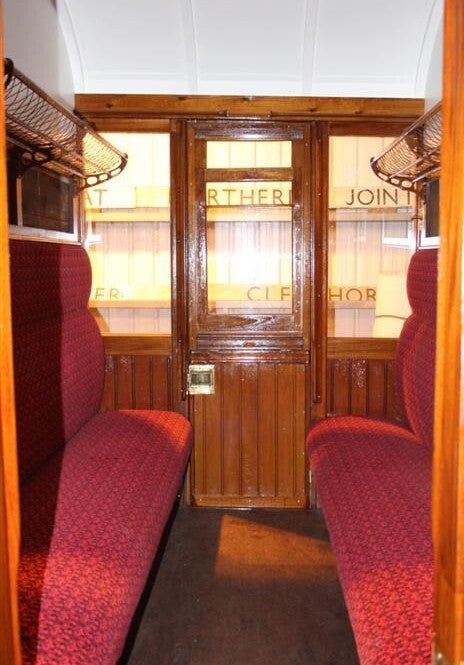
The second-class carriage that Elizabeth was travelling in was typical of the time. Upon opening the door, you had two bench seats (sitting four on each bench) facing one and other and another door on the other side of the carriage
The grim discovery
Her body was tragically discovered half under a bench seat, revealing she had succumbed to severe blows to the head from a blunt object. Investigators quickly noted missing items, including her distinctive green purse and her railway ticket, leading them to suspect robbery as the primary motive. Despite extensive police investigations and numerous potential suspects, no one was ever formally charged, leaving the case shrouded in a century of unanswered questions.
penny illustrated paper 20 February 1897:


THE CAMP FAMILY
William Thomas Camp was born in 1842 at Streatham in Surrey, (South London) and baptised the 1st of May, to William a coachman and Elizabeth, his father died in January 1851, aged 44 years.

Baptised record for William Thomas Camp.
William Thomas a servant married Annie Maryan the daughter of William a labourer, on the 27th day of May 1862, at St. John’s Church, Clapham in Surrey (South London.)
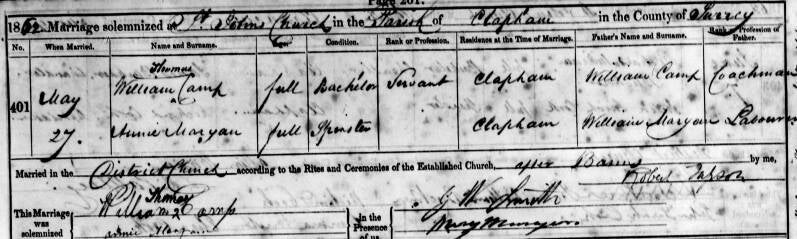
Marriage certificate for William Thomas Camp and Annie Maryan.
William and Annie had three daughters the eldest was Elizabeth Annie in (1863,) then came Annie Mary in (1865) and lastly Fanny in (1869) all born at Shoreditch in Middlesex, (East London) where William worked as a tobacconist assistant. By 1881, the family had moved south of the River Thames, to Newington in Surrey (South London.)
William Thomas died in May 1895. After the death of her husband Annie moved in with her daughter Annie Mary at Hammersmith, she later moved to Queens Road, at New Malden in Surrey, where she passed away in January 1905.
Annie Mary Camp was born on the 11th of November 1865. Annie a milliner (made & sold women hats) married Edward James Sheat an assistant to a clothier, the son of Edwin Benjamin a hairdresser, on the 29th of January 1888, at All Saints Church, Walworth in Surrey (South London.) Annie and Edwin had three daughters and lived in Hammersmith in West London.
They moved to Malling in Kent, where Edwin died on the 8th of January 1940.
Annie moved in with her eldest daughter Gertrude Maud at 5 Peel Terrace, St. Helier in Jersey, Gertrude had married George Philip le Couteur in 1921. Annie died on the 22nd of October 1951, at the Sandybrook Hospital at St. Peter, in Jersey.
Fanny Camp was born in Shoreditch, Middlesex (East London) in 1869, she was baptised on the 26th of June 1870, at St Paul’s Church, in Clapham, in Surrey, (South London.) Fanny married Edwin Hawkes Haynes in 1889, at Camberwell in South London. By 1891, the marriage was over and Edwin and Fanny were living apart.
Fanny a munitions worker of 3 Leonard Road, Southall, died on the 1st of January 1918, at the University College Hospital of carcinoma (cancer) of the oesophagus (a tube from the throat to the stomach.)

Death certificate for Fanny Haynes.
Edwin Hawkes Haynes was born in 1852 at Banbury in Oxfordshire, at 18 he was an apprentice to a grocer at Coventry in Warwickshire, in 1881, he was unemployed and living with his parents at 4 York Terrace in Camberwell, Surrey (South London.)
Haynes a fancy dealer of Lugard Road, Peckham in South London, was up in Court on the 9th of September 1890, for publicly selling certain obscene prints and pictures, he was found guilty of selling obscene photographs and ordered to pay a fine of £50, to enter into his own recognizances in £100 and 2 sureties in £50 each, to keep the peace for 12 calendar months, or in default of finding such sureties to be imprisoned for 3 months (without hard labour) in Wandsworth Prison.
Edwin was found dead in the lavatory, by his landlady at his lodgings in Clyde Road, Tottenham in North London, in June 1917, death was due to heart disease and tuberculosis.
Elizabeth Annie Camp was born on the 19th of September 1863, at 4 Princes Street, Shoreditch in Middlesex, (East London) to William Thomas a tobacco moulder and Annie.

Birth certificate for Elizabeth Annie Camp.
The family moved from Princes Street to 17 Clifton Street North in Shoreditch. Sometime in the 1870’s, the family moved South of the River Thames to Newington, in Surrey, (South East London) in the early 1880’s the family were living at 41 Carter Street, Newington.
In 1885, Elizabeth was employed by Alfred Harris the landlord of the “Good Intent” public house, at East Street, in Walworth, as a barmaid. She left her employment in 1889, when she was employed at the Great Northern Hospital.
Elizabeth spent time as a patient at the Metropolitan Convalescent Institution at Sea Road, Bexhill in Sussex in 1891.
Elizabeth left the Great Northern Hospital, on the 13th of April 1895, and returned to the “Good Intent,” after the death of Mrs. Harris, at the request of Mr. Harris to take the position of manageress.
In March 1895, Elizabeth started courting Edward Berry a greengrocer/fruiterer of East Street Walworth, she had known Edward for several years and they were engaged in July 1896.
THE DAY OF THE MURDER
Thursday the 11th of February 1897, Elizabeth had time off work and had arranged to visit her sisters, one in Hammersmith and the other at Hounslow. She arrived at Annie Mary Sheat house at Kings Street, Hammersmith, at a quarter to two, and left two hours later and made her way to Hanworth Road, in Hounslow, to visit her sister Fanny Haynes, Elizabeth had given Fanny £1 6s., to get something out of pawn. Fanny went with Elizabeth to the station; she had a portmanteau (a large travelling bag) and a parcel with her. She took a single second-class ticket to Waterloo, and got in at the rear, next to a first-class compartment of the 7. 42 p.m. train from Hounslow to Waterloo. She sat with her back to the engine and was alone in the carriage when the train left Hounslow. Elizabeth had arranged to meet her fiancé Edward Berry a fruiterer/grocer of East Street, Walworth, on the platform at 8.25., the time of arrival at Waterloo station.
THE DISCOVERY OF THE BODY
Upon the arrival at 8. 25 p.m. of the Feltham to Waterloo train, the cleaners moved in to give it a quick clean before its return journey to Feltham. One of the cleaners was examining the carriages when he was horrified to find the body of a woman half under the seat. He first dragged her out, and by the light of his lantern saw that the woman was dead, thought the body was quite warm.
The police and a doctor were sent for and on the arrival of the latter the body was removed to St. Thomas’s Hospital. This was later to become questionable as to why the body was removed before the arrival of detectives from Scotland Yard.
A century of speculation
More than a hundred years later, the mystery of Elizabeth Annie Camp’s killer continues to captivate historians and true crime enthusiasts alike. The lack of a resolution has fuelled endless speculation about the perpetrator’s identity, making it a poignant reminder of the darker side of Victorian society and the cases that slip through the grasp of justice. The unanswered questions ensure her story lives on, a testament to an unsolved crime that time cannot erase.
Create Your Own Website With Webador